When a story involves the conduct of a public, tax-funded institution, transparency is expected.
But when that institution has the power to interfere with a journalist’s (or anyone’s) right to speak publicly, the public interest at large, is at risk.
If you’re reading this, you’ve likely also read – or will be about to read – how
Massey University’s Companion Animal Hospital duped me into letting them kill my preciously loved little papillon, Harry (I refuse to use the term “euthanase” because it was a clinical killing under false pretences – and I bring plenty of serious, undeniable receipts, as you’ll see,
here, here and here).
But as I began to “whistleblow” to the media, and to the veterinary and broader pet enthusiasts sectors, I encountered a series of digital obstacles that appear far from coincidental.
For an email address that I’ve used – in a journalistic capacity – to distribute many newsletters, news releases and other such communications for more than a decade, and without ever appearing on one single “blacklist”, that same email address suddenly (just hours after sending Massey the heads-up of my intended expose) began receiving large influxes of uncharacteristic
"timeouts" and
"Access Denied" messages. All this, for an email address sending a media release to exactly the same list of media outlets as I’d distributed to only two weeks earlier, with barely a single issue.
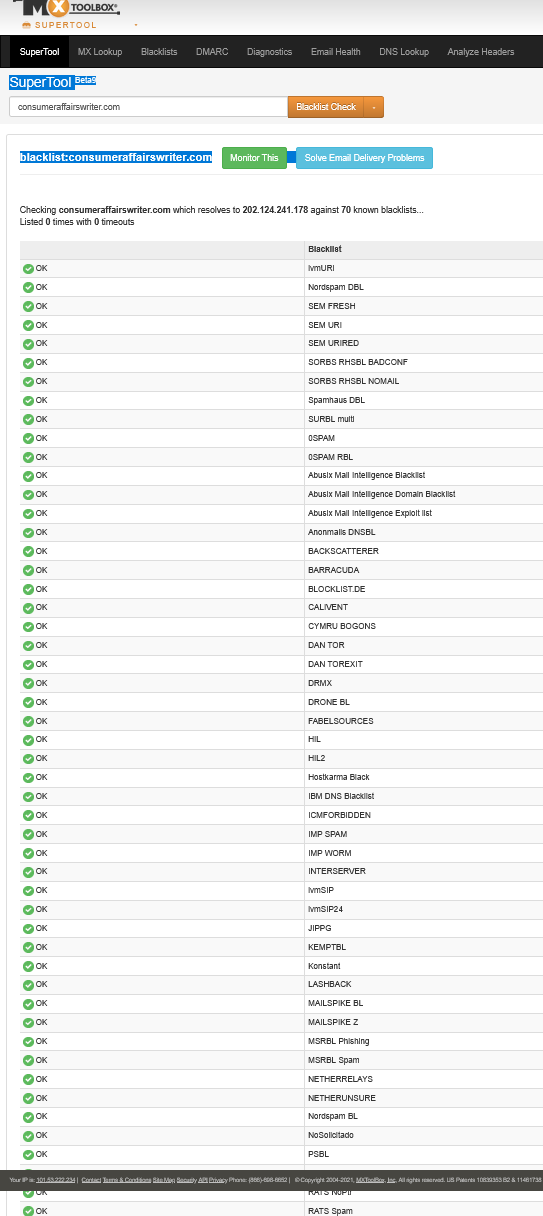
My professional email domain is technically clean. Squeaky clean. A global check via
MxToolbox confirms
zero blacklist listings and a perfect reputation score. Yet, the moment I began sharing news releases detailing my findings at Massey, my communications started hitting brick walls all over the digital sphere.
Crucially, these blocks did not come from the University. They came from the very people I was trying to alert: journalists, the veterinary sector, professional associations and pet-related networks.
The Mechanics of ‘Cloud-Level’ Suppression
In my capacity as a journalist and consumer advocate, I am reporting on a pattern that suggests a sophisticated form of suppression: When an institution mischaracterises an inquiry as "Malicious" or "Phishing" within an internal security network – such as Microsoft 365 – the result is often form of
"cloud echo".
By flagging a domain, an entity can effectively "poison" a professional identity for every other organisation on that shared security network.
So while that institution’s own doors remain open (allowing them to monitor incoming correspondence), the now-"poisoned" domain is prevented from reaching large swathes of the wider public, the media, and the corporate sector.
It creates a digital quarantine, ensuring that clinical and financial details of a controversial case are suppressed before they can reach a broader audience. A very effective and sophisticated behind-the-scenes censorship – but censorship of what YOU see. Not what they see.
All these sudden
Access Denied codes (550 5.4.1 and 5.7.1) received from third parties, occurring in direct chronological proximity to my news releases, raises serious questions about the use of enterprise security tools to silence a client and prevent word of what I contend is a grievous case of intentional malpractice from being exposed to an external audience.
A Matter of Public Interest
Beyond the technical interference of server logs and status codes lies a much deeper constitutional violation. Under the
New Zealand Bill of Rights Act 1990 (Section 14), every citizen is guaranteed the freedom of expression – which specifically includes the freedom to seek, receive, and impart information.
As a public institution, Massey University is not merely a service provider; it is an arm of the state, and as such, it is legally bound by this Act. When a public body uses enterprise security tools to “poison” the reputation of a journalist’s domain, it is no longer managing a network; it’s engaging in state-funded censorship.
A “digital blockade” is a direct assault on the constitutional protections that ensure transparency and allow whistleblowers to hold powerful institutions to account.
Message to Incoming VC Pierre Venter: You’re Stepping Into A Culture of Cover-Ups & Suppression
Again, Massey University is a public institution. It has a duty to provide information, not to oversee its suppression.
If I’m right, Massey’s new incoming Vice-Chancellor, Pierre Venter, would be well advised to commence his tenure by investigating not only this practice, but also by investigating the evidence of deception, cover-ups, and corporate arrogance and unaccountability that I have documented in the material they’re attempting to stop reaching external audiences.
It’s that very culture that saw me fall for the coercion I experienced to get me to authorise the clinical killing of my dog under heinous and directly provable false pretences (read the story here: they put my dog under heavy sedation without cause or consent and without disclosing to me that he was merely heavily sedated, when they presented him to me, instead, as “having had a neurological event” and needing immediate euthanising – a claim that stands in direct contradiction to documented evidence I have since managed to find.
If the details of my beloved dog’s, Harry’s, case are being met with digital interference rather than factual rebuttals, the public must ask why.
In the meantime, I will continue to progressively publish my findings and distribute my news releases and related communications through whatever means necessary – as embarrassing as the exposure may be to Massey, its culture, and to those within it who participated in duping me into authorising the cold, calculated, clinical killing of my dog before I could get him out of their clutches, and get the second opinion that would have revealed the fraudulent diagnosis and alerted me to their cover-up.
LINK
Below: Despite a perfect global reputation score (shown below), the below global blacklists check read-out shows my email address and its associated domain are as "clean as a whistle". Yet my professional communications are being unusually intercepted at some point in their transmission. This data proves that the "Access Denied" blocks are not automated security errors, but would suggest a targeted attempt by someone to suppress a whistleblower.